
Worldbuilding
Types of Entries
Choose useful homes for your people, places and lore, then give each Entry the detail it needs.
Page info
A connected World is easier to build when each Entry has a clear purpose. This guide helps you choose a type, separate its facts from its classifications, and use tags for the qualities that matter to your setting. If you have not created an Entry yet, begin with Getting Started.
Entry types
Every Entry has one type: Note, Location, Region, Character, Faction, Item, Quest, Event or Creature. The type determines the facts and optional prose sections it offers. Choose according to what the Entry represents, rather than where you want to put a pin.
For example, The Lantern is a Location, its innkeeper is a Character, and the river guild is a Faction. Their descriptions belong in separate Entries; connections explain how they fit together. All belong to the same World and can be placed on maps when that is useful.
Start with a title and summary, then add the facts or sections that help tell the story. You do not have to fill every field. A type classification, described under Taxonomies, refines the choice without creating another Entry type.
Places: Locations and Regions
A Location is a particular place, such as a town, tavern, ruin or tower. A Region describes a wider geographic area, such as a forest, mountain range or sea. Both can have pins, so a Region does not need to be reduced to a single building to appear on a map.
Use the scale that serves your story. Morrowwood can be a Region, a ruin inside it a Location, and a shrine beneath the ruin another Location. Connections let you move between them. For a kingdom, separate the land you are describing from the organization that rules it: geography can be described as a Region, while a political organization may be a Faction. A map of that kingdom is a separate view of those Entries, not a replacement for them.
A Location or Region has its own World-level classification. A pin's classification belongs to the map and can depend on its scale. Moving or removing that pin does not change what the Entry is.
Characters
A Character is useful for someone whose identity and story you want to follow: the innkeeper, a ruler, a wandering ghost, or a named dragon. Add the facts and prose sections that matter, such as their occupation, personality and history.
Nature describes their broad nature. It is separate from race, occupation, alignment and who controls them. A Character can be linked to a Player, but there is no separate player-character or non-player-character Entry type.
For the innkeeper, a Home connection to The Lantern and a Member of connection to the river guild say more than repeating those facts in several descriptions. Each related Entry remains useful in its own right.
Creatures
A Creature is useful when you want creature-focused information, such as the species and behavior of the mire drakes that live upriver. A reusable description can help you develop encounters without writing a new article for every sighting.
Character and Creature are separate supported types, but they do not impose a strict rule based on sentience or whether something is an individual. A named dragon with personal loyalties may work well as a Character; a drake description focused on its behavior and habitat may work well as a Creature. Choose the fields and sections that best support how you will use the Entry.
Factions
A Faction is a group treated as an entity: a guild, order, cult, clan or political organization. Use it for the group's purpose, structure and history. The river guild is a Faction; its guildhall is a Location; its leader is a Character.
Connect the innkeeper to the guild through membership, with a role if useful. From the guild, you can follow its members rather than keeping a second copy of each person's story. Connections complement the description; they do not require you to remove the narrative that explains why the relationship matters.
Items, Quests, Events and Notes
- Item: a notable object, such as the guild's seal or an old sword. Record its properties and connect it to its owner where appropriate.
- Quest: an objective or storyline, such as investigating the missing ferry. Use its facts and sections to develop the goal, and Related to connections to connect the surrounding story.
- Event: something that happened, such as a flood or the founding of the guild. Its date and history give the World a past; connections can record where it happened.
- Note: information you want to keep, such as a journal, clue, session note or reference. A Note can be connected to the Entries it concerns.
Taxonomies
A taxonomy is the shared vocabulary behind a classification field. The Entry type answers “what is this Entry?”; a classification answers a more specific question, such as what kind of Location or Faction it is. Other classifications describe status, alignment or similar facts.
Keep those questions separate. The Lantern is a Location; its Category describes the kind of place; its condition describes its current state. A Character's occupation says what they do, not what broad kind of being they are. The available choices keep these facts consistent across your World.
World-level Entry classifications are separate from the map profiles used to classify pins. A map can offer choices suited to its scale without changing the Entry's classification.
Viewing taxonomies in World settings
Open the World menu in the top bar, choose World settings, then select Taxonomies. On a phone, use the Worlds section of the navigation menu. The Taxonomies tab lists the available classifications and their values; these are shared options, not editable lists.
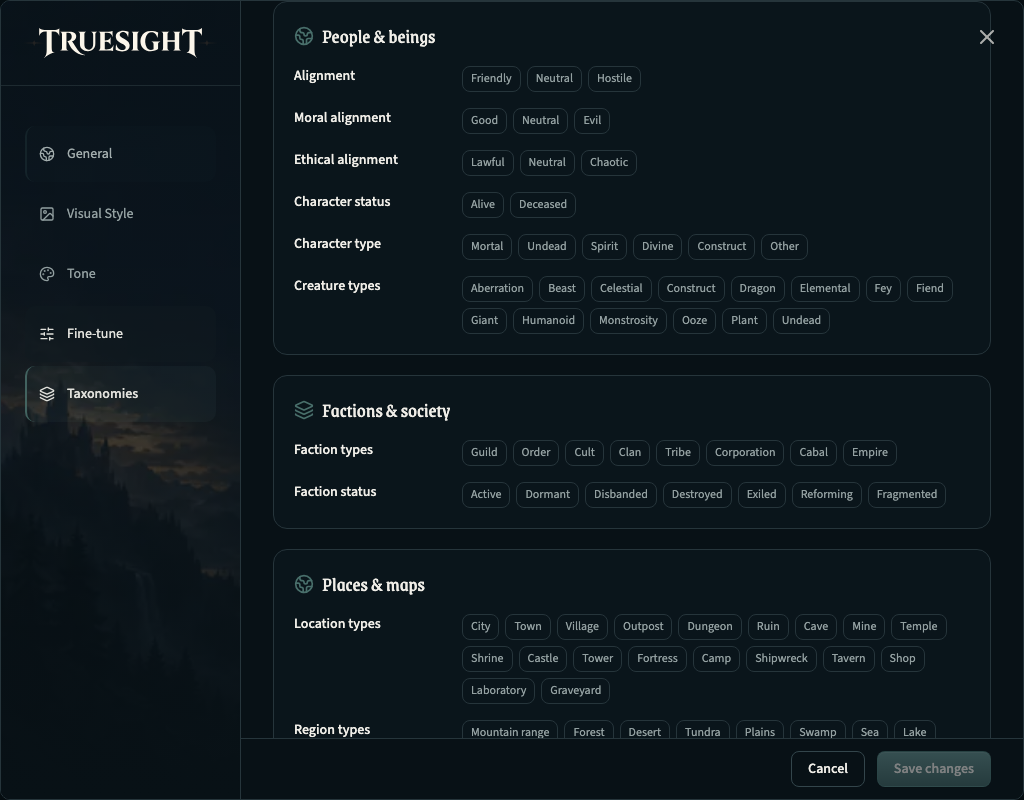
Taxonomy reference
Use this as a guide to the questions each classification answers. For the current value lists, consult World settings rather than keeping a second vocabulary beside your Entries.
| Classification | What it describes |
|---|---|
| Location category / Region landscape | The kind of place or geographic area described by the Entry. |
| Character nature / Creature classification | The Character's broad nature or the Creature's broad classification, separate from more specific facts. |
| Faction category / Item category | The form of organization or kind of object. |
| Quest activity / Event category / Note category | The Quest's approach, the kind of occurrence, or the purpose of the information. |
| Other classification fields | Additional questions, such as status or alignment, with their own choices. |
| Map pin classifications | How a placement is represented on a particular map, using that map's profile. |
Free-form tags
Tags are your own words. Use a shared tag such as “river trade” for the tavern, innkeeper and guild when you want to find them together, even though they have different Entry types. A tag such as “hazardous” can record a quality that does not fit an existing classification.
Use the dedicated facts and classification fields when they answer the question you have. Tags add another way to organize your setting; they do not replace the type or the relationships between Entries.
Custom taxonomies are coming
Classification lists are currently shared across Worlds. Per-World customization is a future direction, rather than an available setting. It would let creators adapt the vocabulary around existing Entry types; it does not mean custom structural Entry types are available today.
For now, choose the closest useful classification and use descriptions, structured facts and tags for the rest. Return to placing Entries and connecting them to turn that organization into a World you can explore.